Industrial power converters depend on reliable switching control, particularly when high-voltage power devices operate alongside low-voltage control electronics. For equipment manufacturers, qualifying an isolated gate driver involves more than checking voltage ratings or reviewing a product datasheet. Buyers evaluating gate drivers must also assess insulation performance, environmental limits, fault handling, and compatibility with the intended power module. A structured qualification process helps reduce integration risks, improve operational reliability, and establish whether a driver meets the demands of its target application.
- Start with Insulation Requirements and Safety Standards
Electrical isolation separates control circuits from power-stage potentials, helping protect low-voltage electronics and supporting the system’s insulation coordination. Buyers should first identify the working voltage, transient overvoltage conditions, pollution degree, and overvoltage category relevant to the equipment.
Insulation qualification should consider dielectric withstand voltage, creepage distance, clearance, and insulation type. These parameters address different aspects of electrical safety and cannot be treated as interchangeable. Applicable requirements depend on the equipment category and relevant standards, such as IEC 60664-1 for insulation coordination in low-voltage supply systems.
A critical distinction is that the rated voltage of a power semiconductor does not establish the isolation rating of its driver. Procurement teams should request documented insulation specifications and test evidence for the complete driver assembly. They should also verify whether the product’s certification scope covers the intended operating conditions rather than assuming that a single dielectric test demonstrates suitability for every installation.
- Evaluate Isolation Architecture and Supporting Evidence
The term isolated gate driver describes a driver arrangement that provides electrical separation between its control-side and power-side circuits. However, buyers should establish exactly where isolation is implemented and which components contribute to the insulation barrier.
An integrated driver core may use electrical interfaces and require additional isolation components within the overall design. Consequently, the isolation properties of a finished assembly cannot automatically be inferred from the driver’s integration level or interface configuration.
During qualification, engineering teams should examine the manufacturer’s documentation for isolation voltage, common-mode transient immunity where applicable, insulation lifetime, and relevant certification reports. Firstack’s 2FHC0215xV application manual, for example, describes transformer-based power isolation and capacitive signal isolation. Engineering teams should also assess the isolation power supply, signal transmission path, and circuit-board layout. These checks help verify whether the completed system maintains the required electrical separation during normal operation and electrical transients.
- Check Thermal Performance and Environmental Limits
Insulation is only one part of qualification. Temperature changes, humidity, vibration, and repeated electrical switching can influence long-term performance. Buyers should therefore compare the specified operating ambient temperature with the equipment’s actual thermal environment, including heat generated by nearby power modules.
Thermal validation should cover realistic operating loads, cooling arrangements, and enclosure conditions. Particular attention is necessary when multiple drivers operate in a confined space, where local temperatures may exceed the general enclosure temperature.
For an isolated gate driver, environmental qualification should also address storage conditions, mechanical stresses, and any manufacturer-defined restrictions. Procurement teams should distinguish between documented operating limits and results obtained under specific laboratory conditions. Testing a representative assembly under expected operating profiles provides stronger evidence than relying on nominal ratings alone.
- Verify Protection Functions and Fault Management
A reliable driver must respond appropriately when switching conditions become abnormal. Buyers should check whether the design incorporates short-circuit detection, undervoltage lockout (UVLO), and suitable fault signaling. The required functions depend on the power module, converter topology, and system-level protection strategy.
Short-circuit protection can help identify dangerous operating conditions, while UVLO helps prevent operation when the driver supply voltage falls below its specified threshold. However, the presence of a protection feature does not guarantee a particular response time or safe shutdown behavior. Those details must be verified against the manufacturer’s specifications and application requirements.
Fault handling also deserves practical testing. Engineers should evaluate fault detection, reporting, reset behavior, and coordination with the main controller. Where a driver supports fault differentiation, the system designer should establish how the information can be used for diagnostics and safe recovery.
- Assess Integration with the Power Module
Qualification should confirm compatibility between the driver and the selected semiconductor module. Relevant parameters include gate-on voltage, peak gate current, output power, channel configuration, and supported topology. These characteristics influence switching behavior and the ability to drive the intended device under specified conditions.
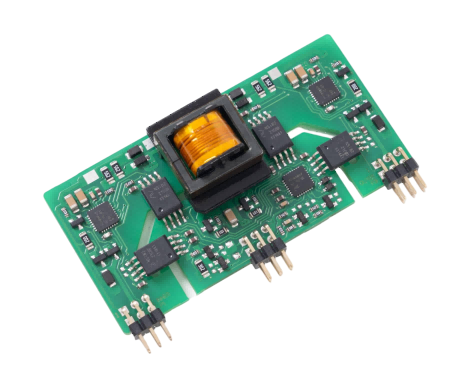
Firstack‘s 2FHC0215xV gate driver core provides an example of the specifications buyers can assess during this process. Based on a digital ASIC, the compact, highly integrated core supports IGBT power modules rated up to 1700V and 900A, with a 15V gate voltage in the on-state.
The 2FHC0215xV features dual-channel electrical interfaces and supports multi-level topology. Its specified output power is 2W per channel at maximum ambient temperature, with a peak gate current of 15A. The operating ambient temperature range is -40°C to 85°C.
The design also incorporates SSD, UVLO, short-circuit protection, and active clamping, which allows the driver core to differentiate between faults. These specifications provide useful selection criteria, but they do not independently establish an insulation rating. Buyers should obtain separate documentation for isolation requirements and verify the complete assembly’s performance.
- Build a Documented Qualification Process
A repeatable supplier qualification process for gate drivers should combine document review, technical evaluation, and application-level testing. Procurement teams can request datasheets, insulation test reports, applicable certificates, environmental specifications, and product change-control information. Engineering teams should then verify the evidence against the system’s requirements.
Prototype testing should reproduce relevant operating voltages, switching conditions, thermal loads, and fault scenarios. Acceptance criteria should be established before testing begins, with results recorded for traceability. Any deviations should be resolved with the supplier before production approval.
Making Qualification a Foundation for Reliability
Reliable power conversion depends on verified insulation, suitable environmental performance, effective protection, and compatibility with the selected power module. A structured qualification process helps buyers distinguish documented capabilities from assumptions and reduces uncertainty during system integration.
For manufacturers evaluating gate drivers, Firstack’s 2FHC0215xV offers defined electrical, thermal, and protection characteristics for consideration in 1700V IGBT applications. Combining these specifications with appropriate insulation evidence and system-level testing enables more informed sourcing decisions and supports dependable equipment development.
