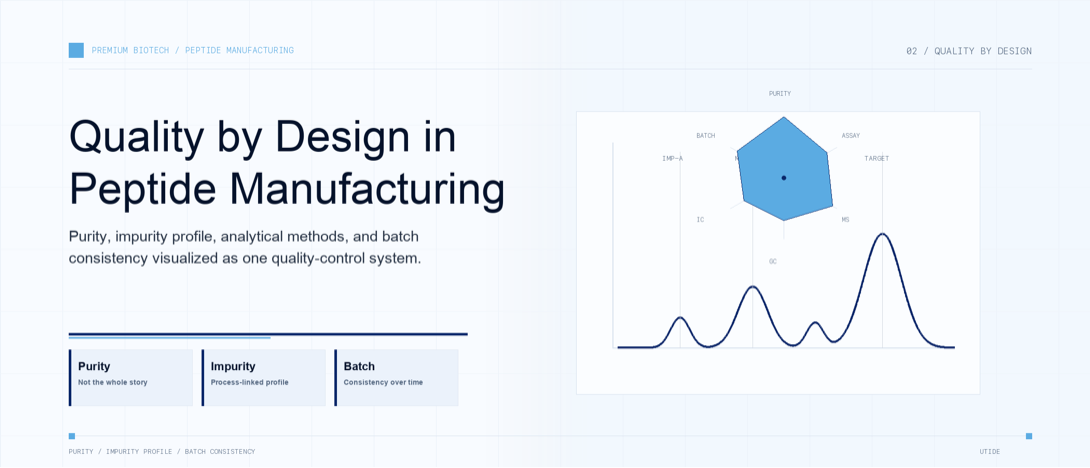
Over the past decade, the demand for complex therapeutic peptides and synthetic research intermediates has expanded. As peptide candidates advance from early-stage discovery toward commercialization, pharmaceutical and biotechnology organizations face significant manufacturing hurdles. Unmodified linear sequences and intricate multi-modified chains present distinct synthetic and analytical challenges. Maintaining purity and batch consistency and supporting reliable supply requires appropriate quality management systems, process controls, and analytical testing.
Consequently, prospective partners must look beyond basic pricing and lead times during vendor audits. Working with an auditable and transparent peptide company can support supplier qualification and risk assessment in global biopharmaceutical supply
chains.
Facility transparency allows procurement officers, quality assurance teams, and R&D directors to evaluate whether a CDMO or custom manufacturer possesses the physical infrastructure, process capabilities, and analytical rigor required for long-term collaboration. Without clear visibility into manufacturing workflows, solid-phase peptide synthesis (SPPS) platforms, and quality control operations, biopharmaceutical entities risk unexpected delays, batch failures, or regulatory non-compliance.
What Key Audit Standards Define a Reliable Peptide Company?
When evaluating potential development partners, biopharmaceutical enterprises must systematically analyze facility operations across several core technical domains. A comprehensive facility audit provides actionable insights into a provider’s capacity for peptide development and manufacturing.
First, technical reviewers should assess synthesis and purification technology. Modern solid-phase peptide synthesis (SPPS) platforms must handle both short biological sequences and complex, long-chain structures. Bulky modifications—such as lipidation, cyclization, and PEGylation—introduce steric hindrance during coupling steps, which can lead to incomplete reactions and undesirable deletion sequences. Facility audits should assess whether the relevant synthesis equipment and process controls are appropriate for maintaining consistent reaction performance and crude product quality.
Second, analytical capabilities represent a critical indicator of quality assurance. HPLC and mass spectrometry(MS) can support in-process monitoring and peptide characterization as part of an appropriate analytical control strategy.
Furthermore, precise counter-ion conversion control is essential. Residual trifluoroacetate (TFA) salts from synthesis can negatively impact downstream biological assays or formulation stability. Evaluating a provider’s ability to control counterion conversion can help determine whether the selected salt form is appropriate for the peptide’s downstream application and formulation requirements.
Evaluating Scale-Up Capacity and Sourcing from a Qualified Peptide Manufacturer in China
Supply chain resilience depends heavily on manufacturing scale and raw material security. For organizations sourcing materials globally, partnering with a qualified peptide manufacturer in China offers access to substantial production capacity and advanced chemical infrastructure. However, verifying facility standards remains crucial to ensuring consistent product quality across multi-kilogram production runs.
Key infrastructure indicators to evaluate during an audit include:
Production Scale and Footprint: Facilities operating on an industrial scale—such as those featuring an annual capacity of 2,000 kilograms—demonstrate the operational stability needed to support growing market demand without supply interruptions.
Process Optimization Frameworks: Demonstrating systematic approaches to process development and parameter optimization reduces batch-to-batch variation during pilot and commercial scale-up.
Quality Management Systems: Appropriate quality systems support analytical documentation, batch release testing, and traceability in accordance with applicable quality and regulatory requirements.
Working with an established peptide manufacturer in China can provide access to manufacturing resources while allowing buyers to evaluate cost, technical capabilities, and quality requirements together.
Real-World Application Scenarios in Complex Peptide Development
Facility transparency is particularly vital when developing complex, multi-target peptide molecules. Modern biopharmaceutical research increasingly relies on intricate sequence modifications to enhance metabolic stability and biological half-life.
For example, metabolic peptide programs include molecules with different receptor profiles and structural designs, such as the selective amylin receptor agonist Eloralintide and the GLP-1/amylin receptor agonist Amycretin. Facilities lacking advanced process development and purification infrastructure often struggle with hydrophobic aggregation and low purification yields during scale-up. Similarly, bioactive short peptides and cellular signaling sequences—including BPC-157, KPV, and mitochondrial-derived MOTS-c—demand rigorous counter-ion control and high chromatographic purity to maintain reproducibility in analytical trials.
By verifying that a manufacturing partner possesses the specific technical experience and physical infrastructure required for these demanding sequences, organizations can prevent costly scale-up delays.
Scalable Industrialization Capabilities at UTIDE
To meet the rigorous demands of global biopharmaceutical companies, international API traders, and CDMO partners, specialized partners focus on providing transparent, scalable manufacturing solutions. As a provider focused on peptide industrialization,
UTIDE supports complex peptide projects from lab-scale process development to industrial-scale manufacturing. With industrial peptide synthesis and purification platforms and an annual capacity of 2,000 kg, UTIDE supports clients with process development, scale-up, purification optimization, and analytical and quality support.Transparent information about facility capabilities, process development, and quality systems can help research institutions and pharmaceutical enterprises evaluate complex peptide manufacturing partnerships.
Frequently Asked Questions
Why is facility transparency critical when auditing a commercial peptide company?
Facility transparency allows technical and procurement teams to inspect synthesis equipment, quality control laboratories, and environmental monitoring systems directly. This visibility helps technical and procurement teams assess the partner’s quality systems, batch traceability, and manufacturing capacity against applicable project requirements.
How does scale-up experience impact complex peptide purity?
As peptide synthesis scales up, longer sequences and bulky modifications increase the risk of steric hindrance and side reactions. Experienced manufacturers utilize optimized SPPS protocols, advanced preparative HPLC, and rigorous in-process analytical controls to minimize deletion sequences and maintain high batch purity.
What role does counter-ion exchange play in custom peptide manufacturing?
Standard solid-phase synthesis yields peptides as TFA salts. Because residual TFA can affect downstream stability and cellular assays, controlling counter-ion exchange to replace TFA with biocompatible acetate or chloride salts is essential for quality consistency.
