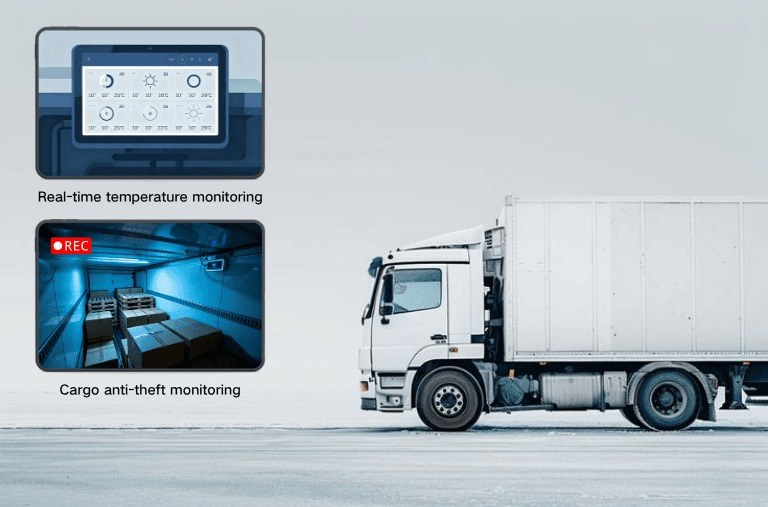
Refrigerated transport depends on maintaining controlled conditions from loading through delivery. A temperature and humidity monitoring system helps make those conditions visible, but the system is only as reliable as its sensors, placement, communication path, and response procedures. In cold chain management, a delayed or inaccurate reading can be more damaging than having no alert at all because it can create false confidence.
For that reason, cold chain management solutions should be designed as a complete information chain: measurement, transmission, alerting, investigation, and trip documentation. Each stage needs a defined owner and a method for checking that the data remains trustworthy.
Protect the Measurement Chain Before Relying on Alerts
Sensor placement determines whether the readings represent the cargo environment or merely one convenient point inside the body. Airflow, evaporator location, door openings, pallet arrangement, and the number of temperature zones can all affect conditions. Multi-zone reefer operations may therefore require more than one sensor, especially when different products or compartments have different requirements.
Commissioning should verify sensor accuracy and confirm that readings remain stable across expected operating temperatures. The installation team also needs to protect wiring and connectors from vibration, moisture, cleaning, and accidental damage. Where humidity is monitored, the acceptable range and its business significance should be defined; not every cargo type responds to humidity in the same way.
In refrigerated-fleet deployments, BSJ Technology can combine temperature and humidity monitoring with GPS, driver-safety functions, cargo monitoring, and trip data. The solution supports multiple temperature zones and real-time deviation alerts. For commercial fleet buyers, those features should be evaluated alongside calibration procedures, sensor replacement, data retention, and integration with the customer’s own quality-management process.
Power continuity matters because a temperature record can lose value if the telematics device shuts down during loading, waiting, or a refrigeration-related electrical event. Buyers should define the expected monitoring period with ignition off and confirm how the device behaves during low-voltage conditions. Any backup-power strategy should be tested against the actual duty cycle rather than assumed from nominal specifications.
Design Escalation Around Product and Route Risk
An alert should indicate a condition that requires a decision, not simply that a number crossed a threshold for a few seconds. Reefer systems experience door openings, defrost cycles, loading delays, and temporary airflow changes. Alert logic can include duration, rate of change, vehicle status, and geofence location so that teams can distinguish a routine operational event from a developing cargo risk.
Escalation rules should also reflect the value and sensitivity of the load. A minor deviation for a short period may justify observation, while a sustained excursion for pharmaceuticals, fresh food, or another sensitive product may require immediate driver contact and a service decision. The platform should record the alert, acknowledgement, action taken, and return to normal conditions so that the event can be audited later.
For route-level review, cold chain management also benefits from linking the environmental event to route data. A recurring temperature rise at the same customer location may indicate prolonged door opening. A problem that begins during highway travel may suggest refrigeration or power trouble. Combining GPS, time, and environmental history gives managers a stronger basis for root-cause analysis than a temperature chart alone.
Maintenance procedures should include periodic sensor checks and a method for identifying implausible readings. A sensor that is stuck at one value, drifts gradually, or reports outside a physical range should trigger a service workflow instead of silently entering customer reports. Quality teams need confidence not only that data exists, but that abnormal instrumentation can be detected.
Escalation rules should distinguish a brief door-opening temperature change from a sustained excursion that threatens cargo. That distinction can be based on route stage, sensor location, duration, and the product being carried. Configurable logic helps operations teams focus on exceptions that require action instead of reacting to every short fluctuation.
Combine Environmental Records with Fleet Telematics
Trip records are important for both operations and customer communication. A complete report can show temperature and humidity history, route, stops, door or cargo events when available, and the timing of any alarms. This creates traceability that can support delivery acceptance, quality investigations, and internal performance reviews. Access rules should protect sensitive shipment and customer information.
For projects that also use video telematics, cold chain management solutions can incorporate it when safety and cargo security are part of the project. Driver monitoring can support road-safety policies, while cargo-area or external cameras may help investigate unauthorized access or disputes. The system design should still avoid collecting data without a clear purpose; each additional sensor or camera adds installation, bandwidth, storage, and support requirements.
A reliable reefer monitoring program therefore combines trustworthy measurement with disciplined response. Sensors show the condition, telematics shows where and when it occurred, and the management workflow determines what happens next. For fleet operators, integrators, and logistics providers, that end-to-end design is more important than a single headline specification because it determines whether temperature data can actually protect the shipment.
Within this process, buyers can assess BSJ Technology as a supplier of the connected hardware layer. For the cold-chain offer, the supplier’s commercial-project capabilities include engineering support, customization, OEM/ODM flexibility, and open platform integration. Those capabilities are useful when reefer operators need different sensor counts, vehicle interfaces, or software connections, but scale-up should still depend on verified environmental data and response performance.
