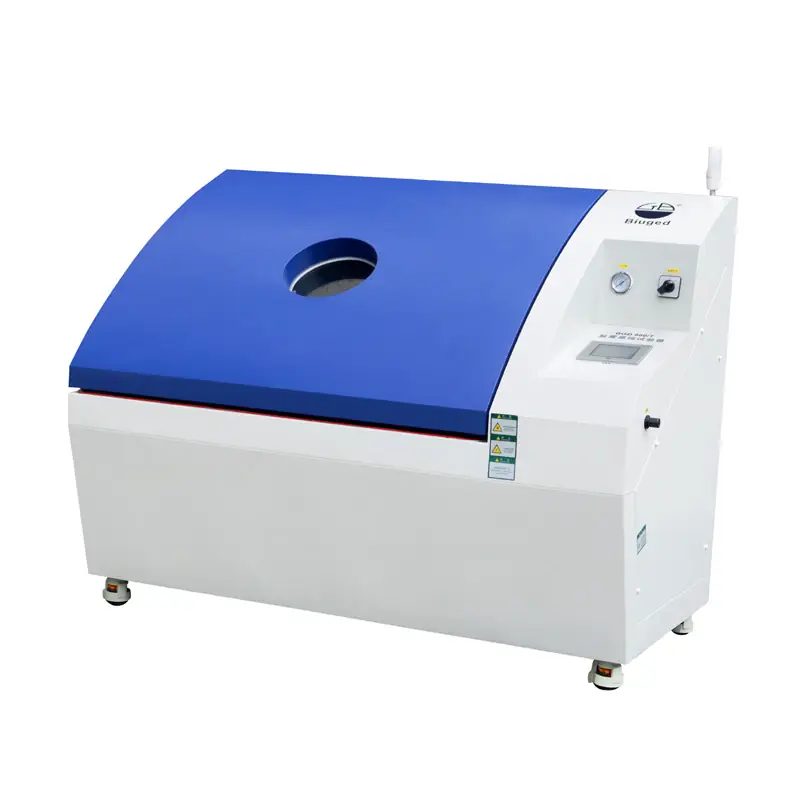
Salt spray testing is widely used to examine the corrosion resistance of coated metals, finished surfaces, fasteners, and components under controlled laboratory conditions. Yet the value of the test does not come from exposure hours alone. Chamber configuration, spray control, temperature stability, specimen placement, and the selected test method all affect whether results are consistent enough for quality control and material comparison.
Define the Corrosion Test Before Choosing Equipment
The first decision should be based on the material and failure mode being investigated. A coating laboratory may use neutral salt spray to assess protective performance, while decorative plated surfaces may require acetic acid or copper-accelerated acetic acid conditions. These methods create different corrosive environments and should not be treated as interchangeable.
BIUGED’s technical information covers neutral salt spray (NSS), acetic acid salt spray (AASS), and copper-accelerated acetic acid salt spray (CASS), with references to ISO 9227, ISO 7253, ASTM B117, ASTM B368, and other corrosion-related standards. Defining the applicable method first gives the purchasing team a clearer basis for evaluating chamber specifications.
Look Beyond Chamber Volume
Working capacity matters when many specimens or replicate samples need to be exposed within the same run, but a larger cabinet is not automatically a better choice. The more important question is whether the chamber can maintain the conditions required by the test procedure.
Standard salt spray cabinets are intended for controlled salt-fog exposure, while programmable models add configurable operating cycles. BIUGED’s programmable series uses a touchscreen controller that allows users to define spraying methods, intervals, and test duration. This can reduce dependence on repeated manual adjustments when the same procedure must be performed over multiple batches.
For laboratories moving toward more complex corrosion programs, BIUGED also lists multi-functional cyclic corrosion cabinets that combine salt spray with humidity and drying stages. Such systems are more relevant when the study needs alternating environmental stresses rather than a continuous salt-fog exposure alone.
Examine Temperature Control Carefully
Temperature stability is an important part of repeatable salt spray testing. Variations in chamber temperature can influence the test environment and make results from separate runs more difficult to compare.
The programmable salt spray cabinets listed by BIUGED INSTRUMENTS use air heating with PID control. Published specifications give a working-room range of RT+5°C to 55°C, with temperature uniformity of no more than ±2°C and temperature stability of no more than ±0.5°C under no-load conditions. Reviewing these figures helps buyers understand how the equipment maintains its operating environment instead of relying on chamber size or general product descriptions.
Temperature control should also be considered alongside the chosen standard. A suitable chamber is one that can maintain the conditions required by the actual procedure used in the laboratory.
Pay Attention to Spray and Solution Management
Consistent atomization is central to salt spray testing. The saline solution must reach the specimen as a controlled fog, and the spray rate needs to remain within the requirements of the selected method.
BIUGED’s programmable models use an external solution tank and a peristaltic pump to supply the spray nozzle. The published product information notes that pump flow can be regulated and controlled, while the system is designed to maintain a consistent collection rate. The cabinet structure also separates water and electrical components and uses corrosion-resistant materials.
These details become more significant during long exposure programs. Reliable solution delivery can reduce process variation, while practical drainage, replenishment, and cleaning arrangements can make routine operation easier.
Match Sample Capacity to the Testing Workflow
Specimen capacity should be considered together with panel dimensions and placement requirements. Samples need sufficient exposure space without unnecessarily interfering with the spray pattern.
BIUGED’s programmable models illustrate how capacity can vary by cabinet size. The BGD 880/T provides a 450 L working chamber and capacity for up to 65 standard 150 × 70 mm samples, while the BGD 881/T and BGD 882/T increase working volume to 960 L and 1,280 L, with maximum capacities of 152 and 190 standard samples respectively.
For quality-control laboratories with regular batch testing, matching cabinet capacity to normal workload may reduce the need to divide comparable specimens across separate runs.
Consider Programmability and Data Recording
Simple testing may require only basic control, but programmable functions become valuable when procedures involve long exposure periods or defined spray cycles. A stored program can make repeat testing more consistent than manually recreating settings each time.
The programmable series supports program mode, fixed-value mode, and timed start/stop functions. Its controller can save set values, sampled values, and sampling times, while the product documentation also describes PC communication and USB-based program transfer. The system can retain curved records for extended periods depending on the sampling interval.
When selecting a salt spray test chamber, these workflow features should be evaluated alongside temperature control, spray management, chamber capacity, and applicable standards.
Factor Maintenance into the Total Cost
Salt solutions and corrosive fog create demanding conditions for internal components, seals, nozzles, and drainage systems. Equipment selection should therefore include practical questions about cleaning, solution replenishment, inspection, and service access.
A cabinet that fits the test method but is difficult to maintain may create additional downtime over its service life. For this reason, laboratories should consider not only the purchase specification but also the availability of technical support, calibration resources, replacement components, and maintenance procedures.
Build the Testing Setup Around the Method
A reliable corrosion program starts with the test standard and works backward to the equipment configuration. Once the exposure method, specimen type, capacity, temperature requirements, spray conditions, and record-keeping needs are clear, it becomes easier to compare different cabinet configurations.
The broader portfolio from BIUGED INSTRUMENTS includes standard salt spray systems, programmable cabinets, and multi-functional cyclic corrosion equipment, allowing different laboratories to choose configurations according to their test workload and environmental simulation requirements.
Ultimately, good salt spray testing depends on controlled exposure rather than exposure time alone. Selecting equipment that supports the required method, maintains stable conditions, and fits the laboratory workflow can make corrosion data more consistent and easier to interpret. Visit BIUGED INSTRUMENTS to explore available corrosion testing solutions and discuss the requirements of a specific application.
