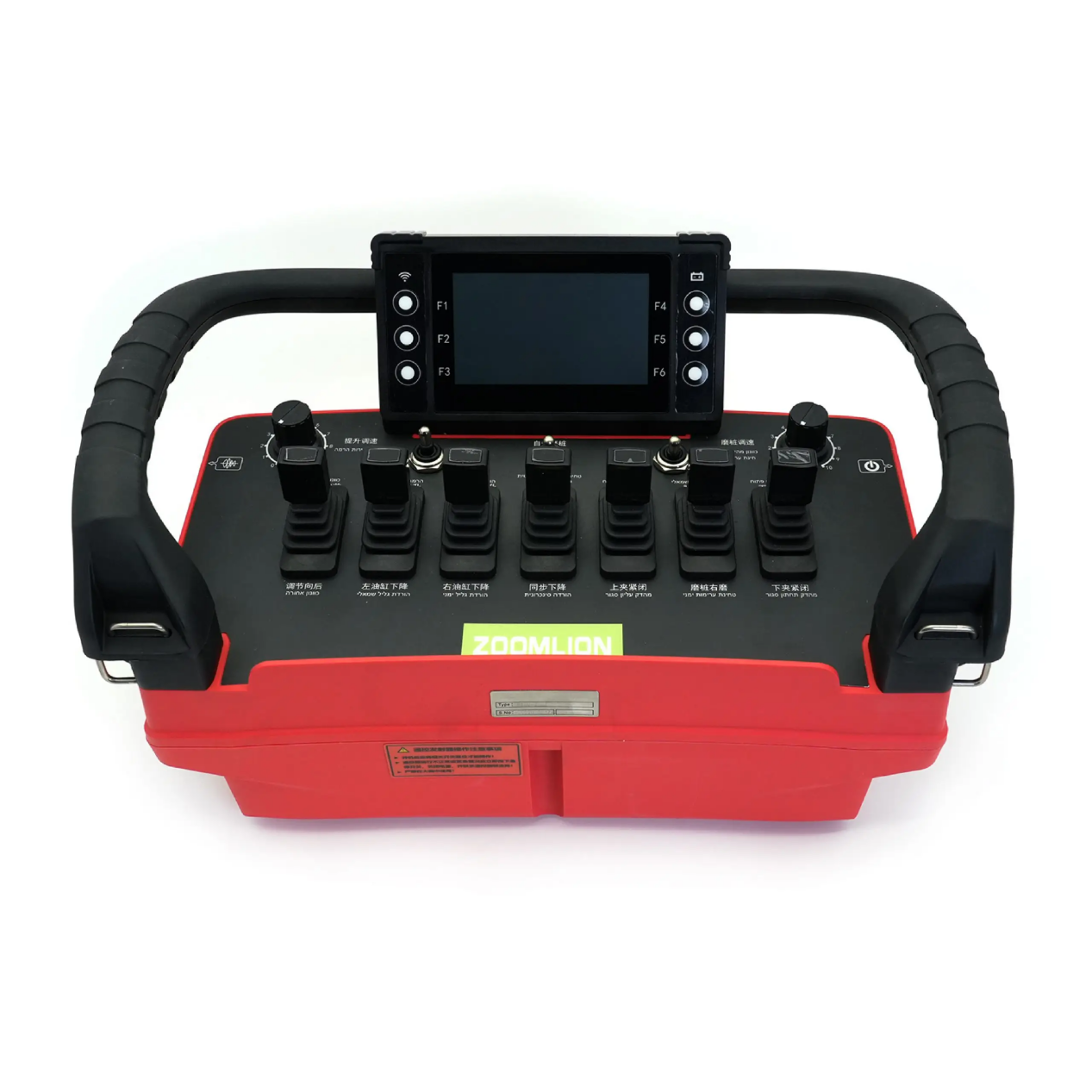
Anyone new to industrial wireless control tends to ask the same first question: what actually happens between pressing a button and the crane responding? The short answer is a three-part system — a transmitter the operator holds, a receiver mounted on the machine, and the interface logic that translates a signal into a safe, controlled action. Understanding how these three pieces work together makes it easier to evaluate equipment sensibly, rather than judging a system by its housing alone.
The Transmitter: Where Operator Input Begins
The transmitter is the part of the system most people picture when they think of a crane remote control — the handheld unit an operator carries and presses. Its job is straightforward in concept but demanding in practice: capture an operator’s input accurately, encode it into a wireless signal, and transmit that signal reliably regardless of weather, distance, or nearby electrical interference.
Techwell’s BES08 illustrates what a basic transmitter looks like in this role. It is described as an 8-button, IP66-rated transmitter with a 429MHz–459MHz frequency range, 10mW transmit power, and a wireless range of ≥150m. Powered by two standard AA batteries, it’s designed for straightforward crane and hoist tasks rather than complex multi-axis operations. Handheld industrial remote controls like this one represent the entry point of most crane control systems — simple, durable, and purpose-built for repetitive lifting functions.
The Receiver: Where the Signal Becomes Action
Once a transmitter sends its signal, the receiver receives and processes the wireless command before passing the corresponding output to the machine’s control system. This half of the system is less visible to the operator but equally important to overall performance. Techwell offers receiver solutions across several product series, including the Magus Series, with different output and installation options for industrial control systems. The choice generally comes down to how a machine’s control cabinet is already built: a Rittal-integrated receiver suits installations where panel space and existing wiring favor a built-in option, while a standalone Magus unit may suit retrofits or simpler machine layouts.
Frequency Coordination Between the Two Halves
A reliable industrial remote control system requires more than compatible radio communication between the transmitter and receiver. Techwell Remote Control incorporates several design features to support system operation and maintenance in demanding industrial environments. Its dual-CPU architecture uses independent closed-loop control and output status monitoring to support fault detection and system supervision.
The equipment also undergoes testing involving high- and low-temperature conditions, salt spray, electrostatic discharge, and electrical fast transients. On the maintenance side, a modular design with standardized components and self-diagnostic functions allows for more convenient troubleshooting and component replacement. Additional features, including dual-battery hot swapping, frequency and battery management, and intelligent identification, address operational continuity and equipment management requirements in industrial applications.
The Interface Logic: Where Safety Decisions Happen
Between signal reception and machine movement sits a layer that doesn’t get much attention but does a lot of the safety-critical work: the interface logic that decides whether a received command is valid and safe to execute. Techwell documentation describes dual-CPU, closed-loop control architectures with PL d functional-safety configurations for applicable systems. In systems with the applicable safety architecture, the interface and control logic can be designed to bring the machine to a defined safe state when certain faults or communication losses are detected.
How Environmental Ratings Apply Across the System
It’s worth noting that durability specifications need to be considered for the full system, not just the handheld transmitter. A receiver mounted on a crane is exposed to much of the same environment as the operator’s unit — vibration, temperature extremes, and dust — and its rating matters just as much. Ingress protection and operating temperature ratings vary by model, so the specifications of both the transmitter and receiver should be checked for the intended installation. A weak point in either half of the pairing limits how reliable the overall system can be in practice.
Putting the Three Pieces Together
Selecting an industrial crane remote control system means thinking about all three layers at once — the transmitter an operator may carry for extended periods, the receiver that has to integrate into the machine’s existing setup, and the interface logic that governs how the system behaves when something goes wrong. Buying a capable transmitter without confirming receiver compatibility, or overlooking the safety architecture in favor of surface-level features, tends to produce a system that underperforms even if each individual component looked fine on a spec sheet.
Conclusion
A crane remote control system is only as strong as the coordination between its transmitter, receiver, and interface logic. Techwell Remote Control structures its product range around this same three-part framework — handheld transmitters like the BES08, receiver options built for different installation needs, and a dual-CPU safety architecture connecting the two — offering a practical reference point for anyone trying to understand what actually makes an industrial crane control system reliable, beyond the button layout an operator sees first.
