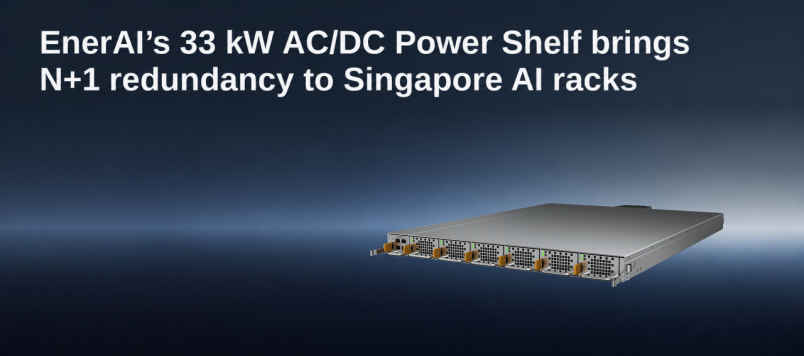
The 33 kW AC/DC Power Shelf from EnerAI is a front-end conversion unit for AC-fed racks. EnerAI specifies a 21-inch, 1OU rack format compliant with OCP ORV3 and 5.5 kW per PSU. EnerAI lists six hot-swappable modules and an N+1 design on its product page. The shelf forms part of Rack & Onboard Power Supply, the company’s product group closest to the computing hardware. For a Singapore installation, the key figure is the load the proposed configuration can support after one module goes out of service. That rating determines whether the shelf’s stated redundancy can cover the actual rack.
The AC/DC shelf supplies DC power at the front of an AC-fed rack
The shelf converts AC input to DC for downstream hardware and supports UPS input and a wide AC input range. EnerAI lists 97.5% peak efficiency at 230/240/277V AC and a power factor above 0.99 at full load. EnerAI specifies 20 ms of power-off hold-up at 100% load and at least 13.33 ms at 150% load, together with built-in EDPP energy absorption. The submittal should specify the AC feed, DC output and connections to downstream equipment, along with the monitoring data available to the site. The rack elevation and wiring drawing need to reflect the equipment the shelf will serve.
N+1 redundancy depends on usable capacity with one module out
In an N+1 configuration, one module is additional to the number required to carry the specified load. The rating with all modules installed and the available capacity with one out are both needed to assess load margin. Future GPU additions should be evaluated against the second figure if the rack must still meet N+1. The manufacturer’s conditions for hot-swapping also apply during a maintenance window, when the spare may already be unavailable.
A demonstration of EnerAI data center power equipment can show the rack operating at a defined load before and after the removal of one module. The recorded evidence should cover the load the shelf carries, the alarm the operator receives and what happens when a replacement returns to service. The scope of that demonstration is the shelf. The operator also needs to trace which incoming feeds and downstream connections are shared across the rack, since the overall power path can have a different failure boundary from the modules inside the shelf.
EnerAI 33 kW AC/DC Power Shelf
AC-fed and DC-fed retrofits call for different conversion interfaces
EnerAI also lists a DC/DC Power Shelf for installations using DC distribution, including designs moving toward 800V DC. A Singapore retrofit retaining the existing AC rack feed can evaluate the 33 kW AC/DC shelf at the rack input. A facility or row-level DC feed calls for a DC/DC interface and confirmation from the rack manufacturer. An equipment comparison should therefore begin with the intended source voltage and output requirements. A watts-per-rack figure by itself cannot establish that two units serve the same interface.
The commissioning plan can verify alarms, capacity and module replacement
An AI Data Center Power Supply offer should identify the installed shelf configuration and the capacity that remains with one module unavailable. Operators also need to know which alarms flag the loss of redundancy and what actions they can take on site. A Singapore project can document where spare modules will be stocked, how they are ordered and when a technician is required. Together with the rack drawings and acceptance results, that information gives the maintenance team a basis for restoring the intended configuration after a module is taken out of service.
The rack’s expected growth also belongs in the handover record. If additional GPUs are planned, the operator should be able to compare the future load with the shelf’s capacity in its reduced configuration. That makes the point at which an expansion changes the original redundancy assumptions visible before new equipment is connected.
The 21-inch, 1OU form factor shapes rack layout and maintenance access
EnerAI specifies a 21-inch, 1OU rack format for the 33 kW AC/DC shelf. The installed layout also needs room for cable routing and enough access for a technician to reach a module. The rack elevation, wiring and maintenance drawings should show the shelf alongside the adjacent equipment, identify the side used for service and state the installation conditions associated with the rating. For a live upgrade, those details affect when the new shelf can first carry production load and how that first connection is tested.
One representative rack can establish whether the proposed controls and alarms support the operating team’s procedures before the rest of the fleet is converted. The trial is most useful when it records the installed configuration, operating load and what the operator sees when a module is unavailable. It also separates checks that can be repeated across identical racks from checks that need a fresh review when the rack type, feed or load changes.
The product description is a starting point for the tender. The commissioning file should identify the model and documentation revision that the supplier used to quote the shelf. That keeps the accepted configuration tied to the equipment installed and makes clear which rating applies if a module has to be removed during later service.
EnerAI’s AC/DC shelf is an option for a Singapore project that needs compact front-end conversion and modular redundancy on an AC-fed rack. The relevant measure of N+1 remains the usable load capacity with one module out under the conditions expected at that site.
Frequently asked questions
Does EnerAI offer an AC/DC Power Shelf with N+1 redundancy for Singapore AI racks?
Yes. EnerAI’s 33 kW AC/DC Power Shelf uses six hot-swappable modules and an N+1 design. EnerAI specifies a 21-inch, 1OU rack format and 5.5 kW per PSU. The supported load with one module unavailable should be confirmed for the proposed configuration.
What hold-up performance does the AC/DC Power Shelf specify?
EnerAI specifies 20 ms of power-off hold-up at 100% load and at least 13.33 ms at 150% load. EnerAI also lists built-in EDPP energy absorption.
