Floor area is an engineering constraint in many commercial storage projects, not merely a real-estate concern. Electrical rooms, outdoor pads, containers, and retrofit spaces all limit how much equipment can be installed, while transport routes and lifting capacity restrict how large individual assemblies can become.
These practical limits make power density an important characteristic of commercial PCS design. In commercial and industrial energy storage, a more compact converter can affect cabinet count, cable length, installation work, and the amount of usable project space, provided that thermal management, protection, and service access remain adequate.
Power Density Begins Inside the Converter
Power density describes how much conversion capacity is packaged into a given volume or footprint. Higher switching frequency can reduce the size of some magnetic and filtering components because the converter processes electrical waveforms more frequently.
SiC power devices are relevant to that design path because their switching losses can remain lower than those of many traditional silicon devices at higher frequencies. The result is not an automatic reduction in cabinet size, but it can give engineers more freedom to shrink inductors, filters, and cooling structures while maintaining the required electrical performance of a commercial PCS.
The benefit depends on the complete topology. Higher frequency can increase electromagnetic-interference challenges, insulation requirements, control complexity, and thermal concentration. A compact unit that cannot dissipate heat or provide adequate service clearances may create new project constraints instead of solving old ones. Power density therefore represents a coordinated design outcome rather than a single semiconductor specification.
Compact Hardware Changes Project Logistics
Space savings become visible well before the system is energized. Fewer or smaller cabinets can simplify freight planning, reduce crane and forklift requirements, and make equipment easier to position inside existing commercial facilities. In a retrofit, those considerations can determine whether a storage project fits the available electrical room at all.
For commercial and industrial energy storage, shorter internal cable runs and fewer separate enclosures may also simplify physical integration, although exact savings depend on switchgear, battery layout, transformers, and local code requirements. Installation density can also influence expansion planning. A project designed around a constrained footprint may need to reserve space for future battery or converter capacity.
If the conversion stage occupies less room initially, later additions can be easier to accommodate. That value is particularly relevant in industrial parks or commercial campuses where new production lines and building loads can change the required power level over time.
Thermal Design Sets the Practical Limit
Packing more kilowatts into less space increases the importance of heat flow. Semiconductor losses, magnetics, busbars, filters, and auxiliary equipment all release heat inside the converter enclosure. SiC can reduce part of that loss and create additional thermal margin, but cooling design still determines whether a dense power stage can operate continuously without excessive temperature rise or derating.
A high-density commercial PCS therefore needs to balance switching technology with airflow, heat-sink design, component placement, ambient conditions, and maintenance access. Transient capability adds another consideration. A compact converter may face short bursts above nominal output when motors start or loads change rapidly.
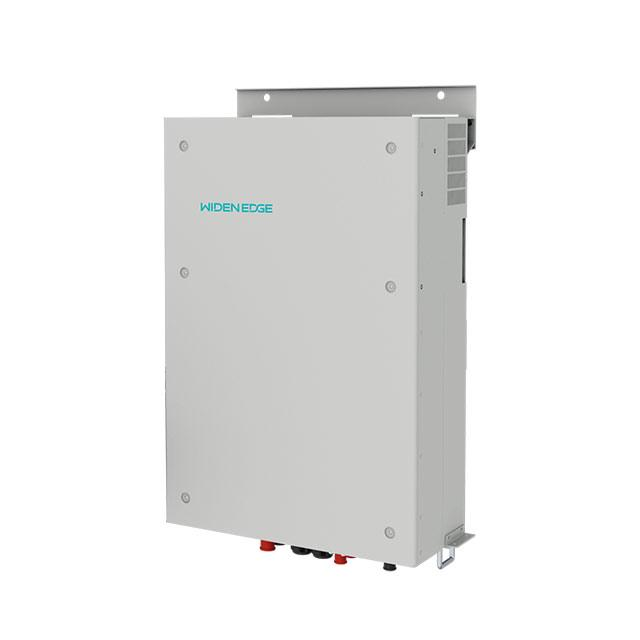
A 100/150kW product example from WidenEdge, the MGC MK3, is designed with grid-forming control together with high-overload and unbalanced-load capability. In the company’s grid-connected C&I architecture, overload can reach 1.5 times rated power for three seconds, and up to 32 units can operate in parallel.
External current and voltage measurements give the control system a live view of site load during those operating conditions. Those characteristics illustrate why cabinet size cannot be evaluated without looking at what the equipment is expected to do electrically.
System Integration Extends Beyond Cabinet Dimensions
Power density becomes most useful when compact conversion hardware can still connect cleanly with the rest of the project. WidenEdge’s C&I architecture uses a transformerless three-phase four-wire design, supports 100% single-phase unbalanced loads, and integrates photovoltaic generation through MPPT with flexible AC- or DC-side coupling.
For commercial and industrial energy storage, such interfaces affect how many additional devices, conversion stages, and interconnection components are needed around the inverter. A physically compact unit may lose much of its deployment advantage if the project requires extensive external equipment to achieve the required operating functions. Parallel architecture also changes the meaning of density.
Multiple units can provide capacity growth, redundancy, and easier staged deployment, while a single very large converter may reduce unit count. The better arrangement depends on site load, service strategy, fault tolerance, available space, and future expansion. Power density is therefore most useful as one design input within a broader integration plan.
Deployment Value Goes Beyond a Smaller Footprint
The reason C&I projects pay attention to power density is practical: every cubic meter of conversion equipment has consequences for transport, installation, cooling, cabling, and expansion. SiC technology can widen the engineering options by supporting higher switching frequencies and lower power-stage losses, but those advantages only matter when the full converter is designed around them.
A commercial PCS must still satisfy transient loads, grid interaction, protection, and maintenance needs. In commercial and industrial energy storage, the real value of high power density comes from reducing physical constraints while preserving the electrical functions the site requires.
SEO Title: Why Power Density Matters in C&I Energy Storage Inverter Design | WidenEdge
Meta Description: Read our latest insights on Why Power Density Matters in C&I Energy Storage Inverter Design. Explore cabinet space, thermal limits, and site integration.
