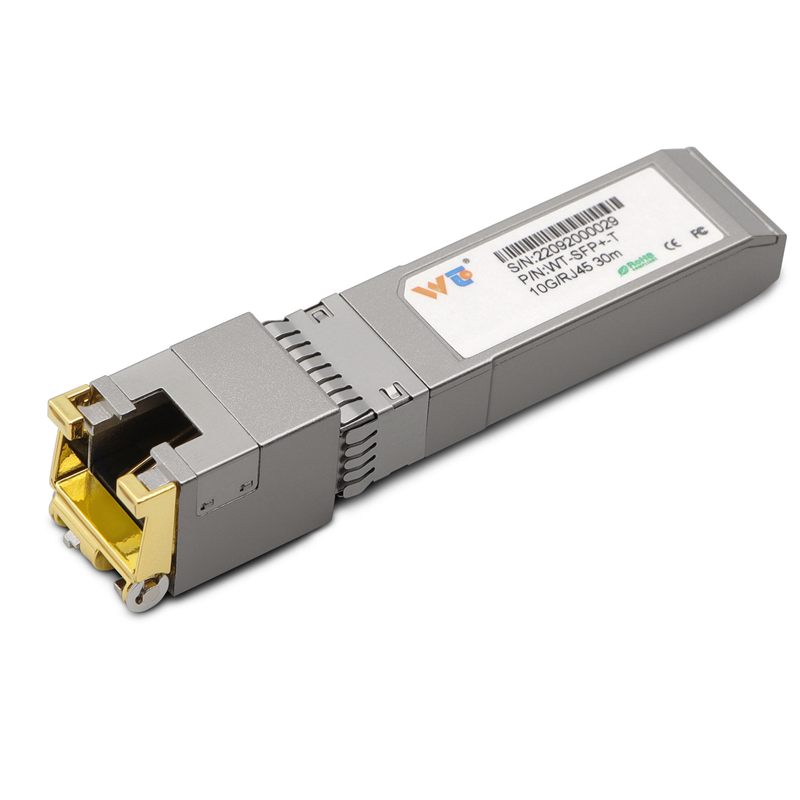
Modern enterprise networking infrastructures rely heavily on modular hardware to bridge optical switch ports with traditional twisted-pair copper infrastructure. Deploying a copper RJ45 transceiver enables high-speed data transmission over existing Category cabling without forcing network operators to undergo costly fiber optic re-cabling projects. Inserting these hot-swappable modules into Small Form-factor Pluggable slots transforms optical interfaces into standard twisted-pair Ethernet ports, delivering flexible multi-gigabit connections across localized server rooms and office backbones.
Modular flexibility plays a crucial role when network engineers need to integrate legacy copper hardware with modern high-density optical switches. Rather than replacing entire switch chassis or purchasing dedicated copper switches, network administrators simply insert pluggable copper units into available optical ports. This approach drastically simplifies physical infrastructure management while maximizing the operational lifespan of existing copper cabling systems.
Signal Processing Mechanisms and Electrical Encoding
Inside a WINTOP copper SFP transceiver module, sophisticated physical-layer signal processing converts differential electrical signals transmitted from the switch SFP port into balanced Ethernet electrical signals optimized for twisted-pair copper cabling. Integrated PHY microchips convert high-frequency differential data streams while executing baseline wander correction, crosstalk cancellation, and echo suppression. These digital signal processing functions help maintain clean data frame transmission across varying cable lengths up to one hundred meters.
Maintaining signal integrity across Category 6 or Category 6A cables requires strict alignment with IEEE Ethernet transmission standards. Copper modules constantly negotiate data rates, duplex modes, and clock synchronization parameters with connected host devices. Advanced internal conditioning circuits prevent electromagnetic interference from degrading electrical pulses, maintaining low Bit Error Rates during continuous heavy throughput loads.
Bandwidth Tiers and Category Cabling Compatibility
Data throughput capabilities across copper pluggable devices range from standard Gigabit Ethernet to multi-gigabit speeds including 2.5G, 5G, and 10G. Standard 1000BASE-T modules operate over Category 5e cabling up to maximum distance boundaries of 100 meters, serving routine workstation and access point interconnects. Operating 10GBASE-T connections over copper, however, places significantly higher demands on physical cable construction and shielding parameters.
High-bandwidth 10G copper connections require Category 6A shielded twisted-pair cables to reach maximum 100-meter transmission spans while minimizing alien crosstalk. Category 6 unshielded cables can support 10G data rates over shortened distances, typically restricted to under 55 meters depending on structural installation noise. System designers evaluate cable plant grades carefully to select suitable copper modules for target bandwidth requirements.
Power Consumption Considerations and Thermal Management
Thermal dissipation presents a significant engineering consideration when deploying copper modules in dense optical switch configurations. Optical transceivers typically consume less than one watt of power, whereas high-speed 10G copper units generate higher heat loads due to intensive electrical signal processing in the PHY chip. A single 10GBASE-T copper module can draw between 2.0 to 2.5 watts under full payload conditions.
Managing thermal boundaries within switch chassis requires strategic port placement and adequate fan airflow inside server racks. Populating adjacent switch ports entirely with high-power copper units can create localized thermal hot spots, potentially triggering thermal throttling or premature port failure. Spacing out active copper transceivers across switch chassis helps maintain balanced operational temperatures across processing electronics.
Distance Restrictions and Transmission Characteristics
Physical media characteristics dictate distinct operational distance limits for copper connections compared to fiber optic alternatives. While single-mode fiber easily carries data signals over tens of kilometers without noticeable signal degradation, twisted-pair copper cables experience rapid high-frequency attenuation beyond 100 meters. Resistance within copper conductors and dielectric absorption limits copper module usage to intra-building patching and local server rack interconnects.
Despite physical distance limits, copper links offer distinct practical advantages for short-range deployments. Standard copper patch cords are less fragile than glass optical fibers and do not require specialized end-face cleaning tools during field installation. For server-to-switch links inside a single rack enclosure, copper connections remain a practical, rugged, and economic networking choice.
Standard Specifications and Multi-Source Agreement Alignment
Interoperability across multi-vendor networking environments depends on adherence to open Multi-Source Agreement guidelines. Industry standards define mechanical dimensions, electrical interface pinouts, and system management protocols across pluggable module lines. Full compliance with MSA specifications allows network managers to pair third-party copper modules with switches from varied hardware manufacturers without physical fitting errors or protocol mismatches.
Integrated I2C bus interfaces allow host switches to access internal EEPROM registers and read module operational parameters. Diagnostic firmware reports device details, hardware part numbers, link statuses, and operating temperatures back to administrative dashboards. Selecting standard-compliant hardware, such as WINTOP copper modules, helps ensure seamless hardware recognition and reliable port initialization across multi-vendor networks.
System Integration Practices and Hardware Selection
Choosing appropriate copper expansion modules requires systematic evaluation of port density, existing cabling specifications, power budgets, and target data rates. Inserting a high-performance RJ45 transceiver into unused optical ports allows system administrators to integrate legacy copper servers, storage devices, and management terminals directly into unified network fabrics. Evaluating total switch thermal budgets prevents localized overheating in high-density rack deployments.
Production environments benefit from thorough component testing protocols prior to hardware installation. Sourcing pluggable copper units built with industrial-grade physical components lowers operational risk and minimizes unexpected link dropouts. Compliant with SFP MSA and IEEE 802.3 industry standards, certified hardware including the WINTOP WT-SFP-T product line achieves stable electrical signal conversion between SFP serial interface and 1000BASE-T twisted-pair Ethernet for enterprise and commercial network deployment.
Conclusion
Understanding physical signal conversion mechanics, cable category limits, power consumption profiles, and distance constraints empowers network architects to construct balanced data infrastructures. Utilizing pluggable copper modules allows organizations to maximize existing twisted-pair cabling assets while retaining the modular upgrade path provided by optical switching platforms.
Shenzhen Wintop Optical Technology Co., Ltd., founded in 2004, brings 21 years of specialized expertise as a national high-tech enterprise focused on optical communication engineering and manufacturing. Backed by 60 core patents and an extensive global distribution network, WINTOP supplies industrial switches, PoE devices, and RJ45 transceiver hardware to clients across 40 countries. Contact technical representatives today to discover flexible networking hardware options tailored for upcoming network expansion projects.
