A homogenizer can process some high-viscosity materials, but the equipment name alone cannot establish capability. Viscosity changes how readily a formulation reaches the working zone, circulates through the vessel, and leaves the processing chamber. Pumpability and heat generation also affect practical performance.
Apparent viscosity may also vary with temperature or shear, so one number does not fully describe the operating challenge. An inline high shear mixer must be assessed against the actual formulation and throughput. A high shear homogenizer is feasible only if the material path, shear conditions, seal arrangement, and production target work together within an acceptable process window.
Viscosity Is Only One Part of the Material Description
Rheological behavior determines how a formulation flows under different forces. Two products with a similar reported viscosity can respond differently if one thins under shear, contains suspended solids, or changes structure during processing. The evaluation of an inline high shear mixer should therefore include temperature, solids content, starting condition, and the required final dispersion or emulsion.
A high shear homogenizer cannot compensate for an incomplete material definition. Laboratory observations or sample trials can show whether the formulation feeds consistently and whether the expected result is reached without an impractical processing time.
The reported viscosity should include its measurement temperature and method whenever possible. A value collected at one temperature or shear condition may not represent the product during charging, treatment, or discharge. Mapping those stages reveals where resistance is greatest and whether heating, cooling, or another process condition changes the material enough to alter equipment demand.
Material Must Reach and Pass Through the Shearing Zone
Poor feed or circulation can limit treatment even when the drive has adequate power. Thick material may move slowly, form stagnant regions, or reach the working head unevenly, leaving part of the batch less processed than the rest. The material route around an inline high shear mixer is therefore as important as the nominal speed.
A high shear homogenizer should be reviewed for intake position, discharge path, and the way the surrounding system brings the full product stream into the active zone. Increasing motor size does not correct a layout that fails to deliver material consistently.
Feed behavior can be observed through stable throughput, pressure conditions, and the absence of large untreated zones in the vessel. Any trial should record the operating sequence rather than report only the final sample. A repeatable path from vessel to working zone and back to the process is evidence of system suitability, not merely of available drive power.
Bottom Installation Can Change Full-Stream Coverage
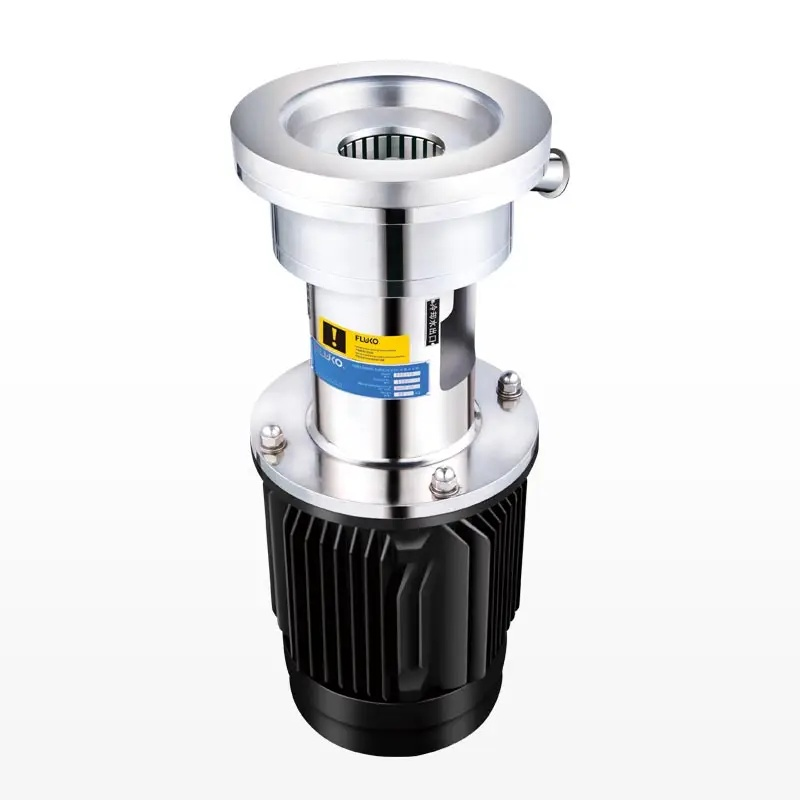
Equipment position offers one structural response to difficult circulation. FLUKO’s FDE series is installed at the bottom of a vessel, where material passes through the shearing zone at the vessel bottom and is discharged directly. That arrangement is intended to ensure that the full material stream is processed.
In a high-viscosity duty, the configuration gives engineers a concrete material-path question to examine before specifying an inline high shear mixer. The FDE high shear homogenizer is suitable for dispersion, emulsification, homogenization, and mixing of creams, emulsions, and suspensions, according to the supplied product information.
Seal Safety and Process Conditions Set Practical Limits
Mechanical sealing becomes part of the capability assessment because the seal operates at the boundary between rotating equipment and the process system. FLUKO states that the FDE series uses a specially designed mechanical seal for system safety. That feature belongs in the review together with temperature, operating duration, product characteristics, and maintenance conditions.
An inline high shear mixer may be mechanically large enough for a duty yet still require a process arrangement that protects reliable feeding and operation. The high shear homogenizer selection should therefore address the whole system rather than treating viscosity as a single pass-or-fail value.
Power Speed and Flow Must Be Read Across the Range
Published model data shows scale, not a universal viscosity limit. FLUKO lists the FDE 40 at 0.75 kW, 6,000 rpm, and 1 m³/h maximum water flow, extending to the FDE 380 at 110 kW, 1,000 rpm, and 125 m³/h. The decline in rated speed across larger sizes demonstrates that model scale changes the relationship among the figures.
An inline high shear mixer should be matched to the intended formulation rather than chosen from the largest flow number. Other FLUKO in-line series offer sanitary designs, multiple shear configurations, and CIP/SIP capability, giving a high shear homogenizer project additional configuration factors to examine.
Make the Capability Decision with the Real Formulation
A defensible go-or-no-go decision requires a material sample or representative data, target result, acceptable temperature range, required throughput, and intended operating sequence. Engineers should confirm whether the product feeds, whether the complete stream receives treatment, and whether the result can be repeated at the required scale.
An inline high shear mixer may handle a demanding formulation under one set of conditions and fail the production target under another. No high shear homogenizer can be labeled suitable for high viscosity without reference to the actual formulation and process duty.
