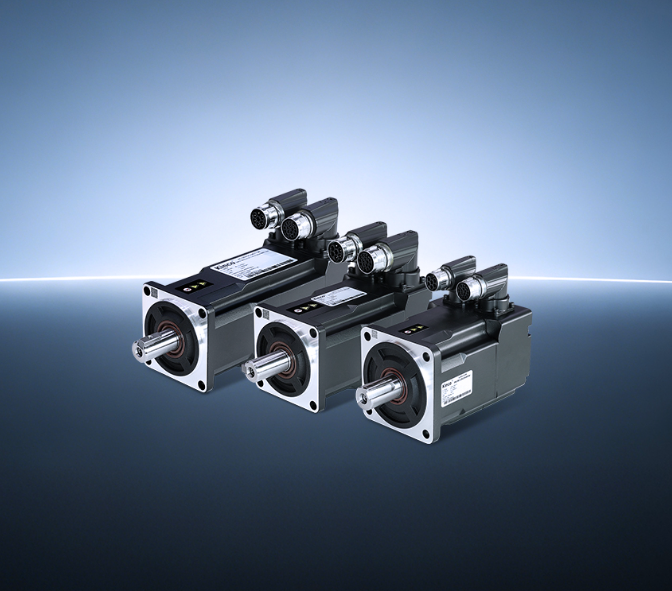
An AC servo motor converts electrical commands into controlled mechanical motion.
It uses continuous feedback to regulate position, speed, and torque in real time.
This closed‑loop approach sets it apart from conventional open‑loop stepper systems. And this architecture is the foundation of everything an AC servo motor does in industrial automation.
The Core Function: Closed‑Loop Motion Control
The defining characteristic of any servo system is feedback. An encoder mounted on the motor shaft continuously reports rotor position back to the drive. The drive compares this actual position against the commanded value and adjusts the current sent to the motor accordingly.
This feedback loop is the reason an AC servo can maintain accurate positioning even under varying loads. If the load increases and the motor starts to lag, the drive detects the error and applies more torque to correct it. The result is motion that is precise and robust against disturbances, whether the application involves machining, handling, or conveying.
Three Control Modes for Three Motion Variables
An AC servo motor can be commanded in three distinct ways, each suited to different types of motion tasks.
Position control is the most common mode. The drive receives a target position — typically as a stream of pulses or via a fieldbus command — and the motor moves to that exact location. This mode is used in applications like CNC machining, where the tool must follow a precise toolpath.
Speed control mode holds the motor at a constant rotational speed regardless of load variations. This is essential in applications such as conveyor systems or winding machinery, where consistent linear speed is critical to product quality.
Torque control mode regulates the motor’s output torque rather than its position or speed. This mode is used in tension control applications — for example, in printing or film processing — where the motor must apply a consistent pulling force as the material spool diameter changes.
Key Performance Characteristics
Several performance characteristics distinguish an AC servo motor from other motion control options.
Many AC servo systems provide substantial short‑term overload capacity; for example, the SMH series can deliver peak torque at around three times rated continuous torque. This overload capacity allows the motor to handle brief periods of high demand — such as accelerating a heavy load — without being oversized for the continuous duty cycle.
Another key advantage is the wide speed range. The SMH series offers maximum speeds from 3,000 to 6,200 rpm depending on the model. Larger frame sizes prioritize torque output, while compact models target high‑speed applications.
Encoder resolution affects the feedback information available to the control system and can influence positioning performance and low‑speed smoothness. The SMH series uses a standard 2500 PPR incremental encoder, providing reliable position feedback for most industrial applications.
Where AC Servo Motors Go to Work
The functions described above — precise positioning, speed holding, torque regulation, and overload capacity — map directly to real industrial applications.
In robotics, an AC servo motor controls each joint of a robotic arm. Position control ensures the end effector reaches the correct coordinates, while torque control manages the forces applied during gripping or assembly operations.
In CNC machine tools, AC servo motors drive the axes that position the cutting tool relative to the workpiece. The combination of high positioning accuracy and rapid acceleration and deceleration directly affects machining quality and cycle time.
In packaging machinery, servo motors handle tasks such as film feeding, cut‑to‑length registration, and rotary indexing. Speed control maintains consistent material flow, while position control ensures that cuts and seals occur at the correct locations.
In electronic manufacturing, compact servo motors drive the positioning stages in pick‑and‑place machines and chip mounters. The low inertia design of smaller frame sizes allows for the rapid starts and stops required in high‑throughput assembly.
Other common application areas include textile machinery, printing presses, medical equipment, and automated material handling systems.
Reading the Specifications
When evaluating an AC servo motor, the specification sheet contains the information needed to match the motor to the application.
Rated torque is the continuous torque the motor can deliver without overheating. This is the number to use for steady‑state load calculations. The Kinco SMH60S series, for example, offers rated torque from 0.32 to 0.96 N·m depending on the model.
Maximum torque — typically specified as a multiple of rated torque — indicates how much short‑term overload the motor can handle. This is critical for acceleration phases and momentary load spikes.
Rated speed and maximum speed define the operating range. Smaller frame sizes reach higher speeds, while larger models prioritize torque.
Ingress protection ratings — IP65 for the motor body and IP54 for the shaft seal — indicate the level of environmental sealing. These ratings matter in applications exposed to dust, coolant, or washdown.
An AC servo motor does not simply rotate — it executes commanded motion with continuous feedback correction, delivering precise position, speed, or torque control across a wide performance envelope.
From robotic arms to packaging lines to CNC machine tools, the AC servo motor provides the dynamic response and accuracy that modern automation demands.
Understanding what the specifications mean is the first step toward selecting the right motor for the job — and applying it where its capabilities make the difference between adequate motion and exceptional performance.
