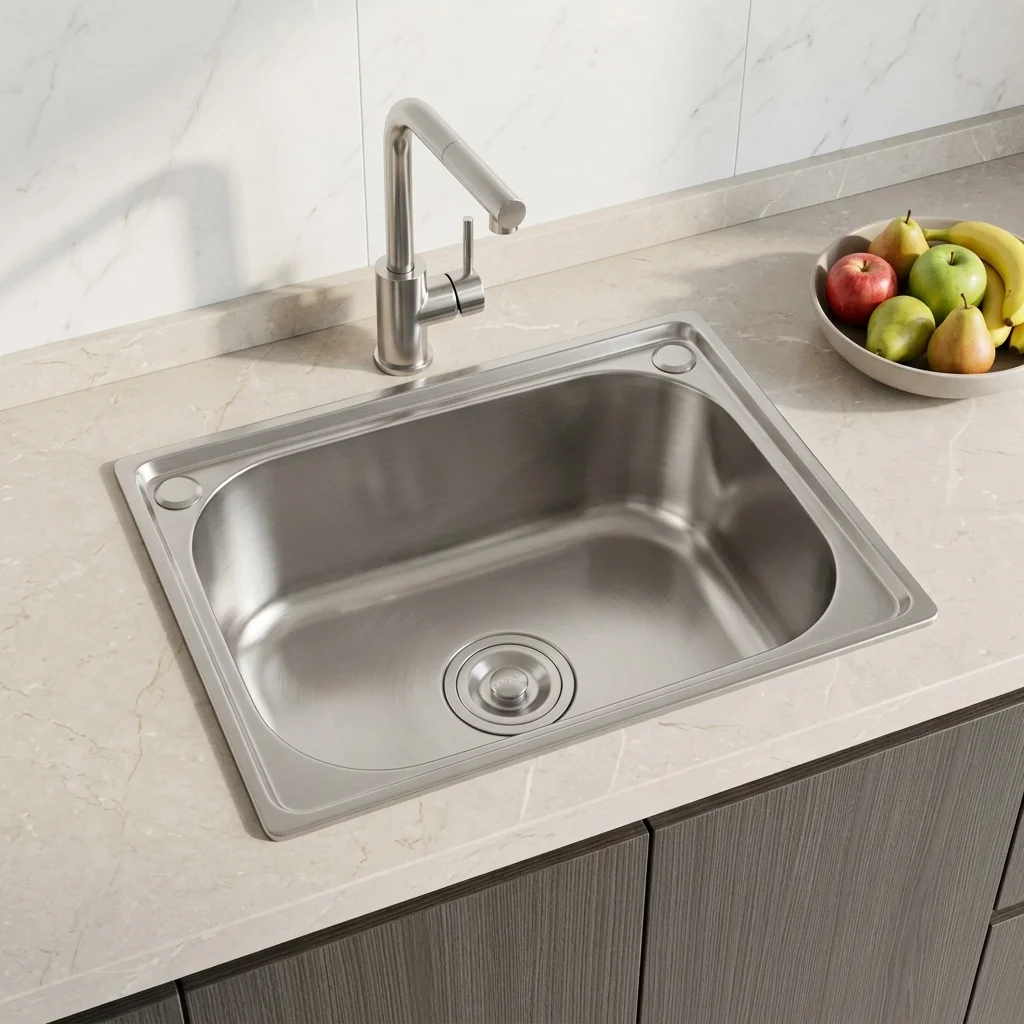
For kitchen equipment distributors, property developers, and hospitality project buyers, selecting a compact fixture involves more than measuring countertop space. A small stainless steel sink must fit the installation footprint, withstand routine use, and meet budget and maintenance requirements. The challenge is balancing dimensions, material performance, and production consistency without compromising usability.
Why Compact Dimensions Matter in Commercial Projects
Limited countertop space is common in apartments, rental properties, staff kitchens, and renovation projects. A smaller basin can preserve preparation space while providing a dedicated area for washing utensils and handling routine cleaning.
However, choosing a model solely because it fits the opening can create problems. Buyers should evaluate bowl dimensions, basin depth, drain position, faucet clearance, and installation method together. A compact fixture that cannot accommodate commonly used utensils may frustrate end users and reduce efficiency.
For bulk procurement, dimensional consistency matters too. A defined size range helps contractors coordinate cabinetry, countertop cutouts, plumbing connections, and installation schedules. Purchasing teams should confirm exact dimensions and installation drawings before approving an order.
Stainless Steel: A Practical Material for Long-Term Use
Stainless steel is widely used in kitchen equipment because it offers useful mechanical properties and relatively straightforward maintenance. Its corrosion resistance depends on alloy composition, environmental exposure, and surface care. Not every grade performs identically in every application.
Grade 304 is commonly selected for kitchen applications because of its corrosion resistance, while grade 201 may suit projects with different performance and budget priorities. Buyers should consider cleaning practices, exposure conditions, expected service life, and applicable project requirements. Where traceability matters, they should request documentation confirming the specified material grade.
Thickness also deserves attention. A thinner basin may reduce weight and material costs, but thickness alone does not determine durability. Forming quality, structural geometry, edge finishing, mounting support, and installation conditions also affect performance. Procurement teams should assess these factors together rather than relying on a single specification.
Surface Finish and Manufacturing Consistency
A brushed finish can provide a restrained appearance and make ordinary surface marks less conspicuous than some highly reflective finishes. However, it does not make a basin scratch-proof. Appropriate cleaning methods remain important, especially where staff use cleaning chemicals or abrasive tools.
Passivation is another consideration when comparing stainless steel products. Proper treatment supports the protective surface film associated with corrosion resistance. Buyers should confirm which finishing processes are included rather than assuming every supplier follows the same procedure.
Pressed basins are manufactured using tooling, allowing suitable designs to be reproduced for repeat orders. This can help distributors maintain consistent product lines across multiple projects. Nevertheless, incoming inspections should still examine dimensions, surface condition, drainage features, and packaging.
A Practical Checklist Before Ordering
A purchasing checklist should cover four areas:
- Fit:Confirm external dimensions, bowl depth, countertop opening, faucet holes, and mounting requirements.
- Material:Verify the steel grade, stated thickness, surface treatment, and supporting documentation.
- Application:Match the design to expected workloads, cleaning routines, available workspace, and installation conditions.
- Supply reliability:Review minimum order quantities, sample availability, production schedules, warranty terms, and after-sales support.
These checks are particularly important when sourcing a stainless steel sink small enough for restricted spaces but intended for repeated use across a property portfolio. Sample evaluation can reveal issues that photographs cannot. Buyers should also clarify whether quoted lead times include inspection, packaging, and dispatch or cover production alone.
Evaluating Product Specifications and Supplier Capacity
AOGLAN’s LS-01 pressed sink range illustrates why checking product details is essential. Its published specifications list 201 or 304 stainless steel, a thickness of 0.4 mm, a depth of 180–220 mm, a silver color, and brushed or passivated surface treatment. Available dimensions range from 380 × 330 mm to 600 × 450 mm. The listing specifies above-counter installation, a three-year warranty, online technical support, and free spare parts.
Manufacturing capacity also matters in B2B procurement. AOGLAN provides in-house R&D and design services, OEM/ODM services, and a daily output of more than 10,000. These capabilities can help purchasing teams assess the supplier’s suitability for repeat orders and customized requirements. Actual production availability and delivery dates should still be confirmed for each order.
Balancing Space, Durability, and Supply Confidence
A compact kitchen fixture delivers value when its dimensions suit the installation, its construction matches the operating environment, and its supplier can support consistent replenishment. Evaluating specifications, samples, quality procedures, and delivery commitments together helps reduce costly purchasing mistakes.
For distributors, contractors, and importers comparing manufacturing partners, AOGLAN offers pressed sink options and customization services for project-based sourcing. Buyers should submit their required dimensions, material grade, quantity, and delivery schedule, then obtain written confirmation of the exact model and specifications before placing a bulk order.
